

I’m excited to share that my new book, Copilots and Agents for Dynamics 365 Business Central, is now available from Packt. 🎉
This book originated from an idea I had over a year ago, when, while speaking with partners, I realized there was a great deal of confusion regarding how to create AI solutions for Business Central.
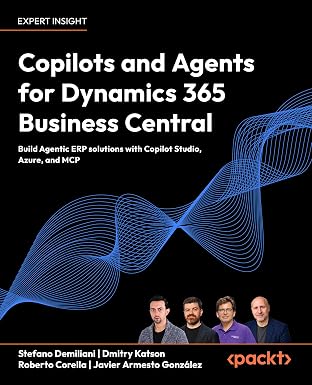
I therefore decided to involve 3 friends who agreed immediately, and whom I must thank, because without them, all of this likely would never have come to life: Dmitry Katson, Roberto Corella and Javier Armesto González.
Why this book?
ERP is changing. Systems that used to record transactions can now reason over data, take actions and automate whole processes. Business Central already ships with copilots and built-in agents, and it offers many ways to build your own: AL, Copilot Studio, Azure Logic Apps, MCP and .NET. The hard part is choosing the right approach and then making the solution secure, testable and affordable to run in production.
That is what this book is about: how to design, build, test and govern AI solutions for Business Central, not just demo them.
A hands-on journey with Cronus Events.
Instead of presenting features in isolation, the book follows a fictional company, Cronus Events, as it adopts AI across its business. Every chapter solves a realistic problem, so you see how the pieces fit together.
What’s inside?
1. Introduction to LLMs and AI agents. What LLMs and agents are, how LLMs process language and enable automation, where AI fits in Business Central, and why integrating it matters. No AI background is needed.
2. Creating AI agents with Copilot Studio. You build the Cronus Events agent, configure its knowledge, add skills for structured conversations, and connect it to Business Central. You then build connected agents for a speaker portal, test and publish them, and apply enterprise best practices.
3. Creating copilots in AL with the AI Development Toolkit. Your first copilot, structured output, advanced UI and attachments, generation history, prompt options and tool calling, plus how to manage costs and performance.
4. Testing AI solutions. Why testing AI is different, data-driven tests with the toolkit’s evaluation features, testing copilots with structured output and tool calling, external evaluation with Microsoft Foundry, and best practices for production-ready evals.
5. Business Central’s built-in AI features and agents. How to govern Copilot and agents, how to chat with Copilot, and how assistive copilots help in daily operations. You also see the Payables Agent process vendor invoices, Copilot reconcile bank accounts, and the Sales Order Agent handle sponsor requests.
6. Designing a custom agent with the AI Development Toolkit. The step from copilot to agent: finding a good agentic process, using the Agent Design experience, writing instructions, staying in control while the agent runs, making an existing app agent-ready, evaluating the agent and preparing it for production.
7. The standard Business Central MCP server. Publishing the Cronus Events APIs through MCP, testing them with an MCP client, building an attendee assistant with Copilot Studio, and securing and operating the integration.
8. Agents with Azure Logic Apps Agent Loop. Why Agent Loop, multi-agent workflows and patterns, testing, observability and continuous improvement, Logic Apps as an MCP server called from Copilot Studio, and a complete multi-agent workflow for Cronus Events.
9. .NET and Microsoft Agent Framework. The framework’s basics and workflows, a Q&A chatbot for Cronus Events, and best practices and common pitfalls for when you need full control.
Throughout the book you’ll also see semantic search for optimizing custom agents, and human-in-the-loop controls for keeping people in charge.
Who is this book for?
The book is written for Business Central developers, consultants, solution architects and implementation partners. Functional consultants can use it to prototype agents and work with development teams. You should know Business Central and basic AL. Some familiarity with .NET helps for the .NET chapter. You don’t need any prior experience with LLMs or AI agents.
How to get the book?
You can find it on Packt here or on Amazon here. If you read it, I’d love to hear your feedback. And if you’re building agents for Business Central, let’s talk.
A big thank you to my co-authors, the reviewers at Packt, and everyone in the Business Central community who supported this project.💚


